
It's Not That Deep...Or Is It?
On hypervigilance, locker room laughter, the n-word, and me as a little girl

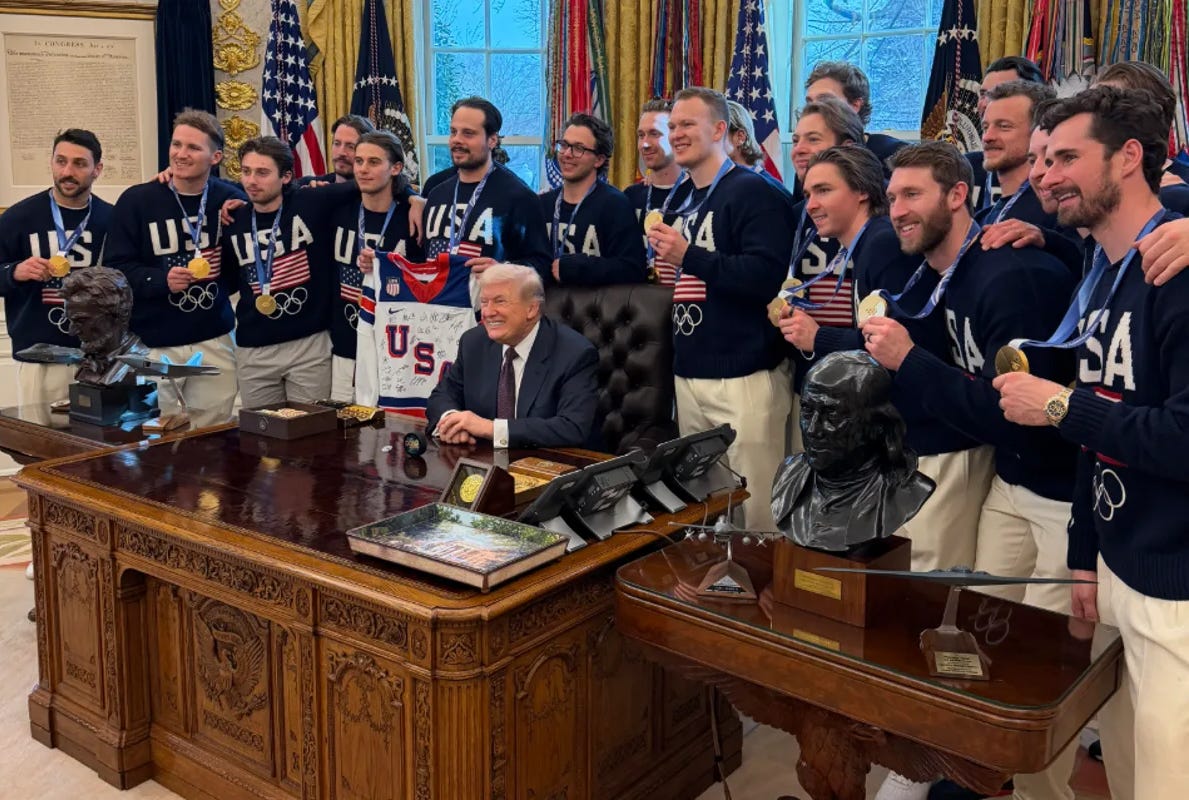
I didn’t want to write about Trump’s congratulatory call to the men’s Olympic hockey team this week after their historic win. But something about how familiar — how personal — that call was, misogyny literally entered the short chat, how thoughtlessly their response to his remarks was shared — gnawed its way into my psyche and won’t let go.
I didn’t want to write about the British Academy Film Awards either, where award winner John Davidson repeatedly blurted out the n-word in the hall, and where the BBC chose to air his outbursts unedited while cutting filmmaker Akinola Davies Jr.’s free Palestine speech. But something about how many people are still willing to hop on god’s internet and defend the n-word — defend the silence, defend the complete lack of apology from Davidson — got under my skin.
I didn’t want to write about these things, as I’m running on the fumes of the exhaustion, rage, and grief I feel about the Epstein files. About our government’s involvement in an epically unethical cover-up. About its worldwide implications on wars, genocides, continued child trafficking, and labor. About white supremacists’ feverish, frantic child abductions and trafficking in Texas — little five-year-old Liam and his blue beanie snatched from the backseat of his family’s car, eleven-month-old baby Amalia who nearly died of pneumonia in a concentration camp there, sweet two-month-old Juan Nicolas deported to Mexico while gravely ill with RSV.
But then I thought about my own mother’s terror — the terror she carried with her in every situation when I was a child. Having a full-blown panic attack whenever she rushed us to the hospital with an injury or illness. Reminding us we could be “taken” from her at any moment. An anxiety she carried, her mother carried because it had happened to our ancestors. Still happens to Black mothers every day.
When I thought about the many times I have felt alone as men I loved laughed along while I was the butt of the joke, standing right there in the same room. About how often I have felt denigrated and demoralized by what to them was an every-day-run-of-the-mill comment or joke.
About how my closest friend in 7th grade — Mexican, a brown girl herself — once muttered about her stepmother under her breath: “I hate that n——.” About how after I confronted her, she insisted she hadn’t meant it instead of apologizing. How I spent the rest of middle school wandering alone at lunch, haunted by what she’d said, desperate for someone to sit with.
When I thought about how many times beyond that one incident, I — a child of the ‘80s and ‘90s — still heard that word. How my mother was called it with regularity as a child. How she still shrinks at the mention of it. How it still has the power to incite fear, to empower violence.
About how, in the many DEI discussions I was forced to engage in the summer of 2020, I sat through far too many conversations where white acquaintances, friends, and even family felt the sudden urge to confess they’d said it — as if I, a biracial woman, was their personal priest. In a confessional booth. A quick sinner’s prayer. Exorcism. And unearned absolution.
When I thought about the time I, as a little girl, was swimming in the pool with an older cousin — my stepmother’s nephew — at a big pool party at a family member’s home. How this boy, 13, and I, 9, were often left alone together despite my discomfort. Despite his repeated bullying and sexual harassment. How, even now, I feel like I want to tell you lest you think I’m being too hard on him: That I know he was 13, know he likely had no idea how harmful his actions were, know he never actually sexually abused me. And yet.
On an otherwise average Saturday afternoon in a pool in a suburb of La Mesa, California, he was especially aggressive. Irked and agitated by what, I did not know. Chasing me down in the water. Pulling me under repeatedly, then letting me up for air just in time.
I eventually crawled to the edge of the pool and scraped my knees along the side to scurry away from him as fast as possible. Breaking the cardinal pool rule, I ran straight for my dad, who was standing in a crowded room with a group of other men. Dripping wet, bloodied knees, tear and snot-streaked face, I breathlessly cried out to him, hurriedly confessing what had happened to me.
The room grew silent — and then the men he was standing beside chuckled. And then he, a little red in the face, reluctantly chuckled too. And told me not to be so sensitive. I sat, wrapped in a towel, sullen and scared at the edge of an outdoor sofa for the rest of the night as the other kids played.
Even now, I feel compelled to defend him — to wonder if I explained myself clearly enough that day for him to really understand. I know that’s not who he usually is.
But, as much as I love him, as much as I can imagine his intent, I can’t, and I won’t defend anyone who looks away or laughs along. Because they’re not the ones who need defending. We are.
Our film team at The Who We Are Project has been researching our docuseries episode set in San Antonio, Texas, exploring the history of freedom seekers who established Freedom Colonies in the Texas wilderness. Many had escaped enslavement to find refuge in these settlements. And some of their descendants have somehow, despite constant attacks, held on to their land.
But because of eminent domain and adverse possession laws still on the books in Texas, Black ranchers can never be sure the land will remain theirs. These laws allow the government or another citizen to lay claim to land they deem isn’t being used. It means many ranchers’ land is constantly under threat of legalized theft. And so it is common practice for these farmers to ride the full perimeter of their property daily, scanning for squatters, prepared to fight anyone who tries to push the line.
No one is meant to live like that — in a state of continuous threat, ever watchful. But they do, they must, if they want to keep what’s theirs.
And as soon as I learned about this practice, something in my bones recognized it. That feeling, the feeling of being on constant edge, on continuous alert, was all too familiar.
Hypervigilance.
Scanning crowds, doomscrolling the news, checking our workplaces, our relationships for signs the winds have shifted. Even in moments of celebration and accomplishment. Wondering —always— am I safe?
So many of us are living in this heightened state of awareness every single day. Always scanning the perimeter. Always watching for signs of danger, of threat.
Still, there are many people in this country who do not want, or do not care to see this. Who would say to me, and who have: It’s not that deep.
That there’s no connection between the n-word at the BAFTAs, and the laughter in that locker room, and me wrapped in a towel as a nine-year-old at the side of the pool, afraid to get back in. And modern-day Black and indigenous ranchers riding along their perimeter, constantly watching. And Trump’s comments about how immigrants are “eating the dogs, they’re eating the cats.” And people dying in for-profit concentration camps in the U.S. And children being raped and trafficked. The BAFTAs, the Olympic locker room laughter — just unfortunate, one-off social faux pas, accidents, mistakes.
And, I get it: John Davidson, the man who hurled those insults at the film awards, is not a monster. He has Tourette’s. No matter how deeply he may not have wanted to make the association between the n-word and actors Michael B. Jordan and Delroy Lindo, his brain made that connection. His body involuntarily said those words.
But that, right there, should tell us something. Racism is the default. Not just for him, for all white people.
Similarly, I suspect not every man in that Olympic men’s hockey team locker room agreed with Trump’s hurtful words. But misogyny is what they defaulted to. The most available and acceptable response.
I know my dad, and in nearly every other circumstance, he would have run to comfort me, would have and did come to my defense. But it matters that in this instance, he didn’t.
Because what and who you are willing to go along with exposes who you — who society — believes is disposable, expendable, abusable, and exploitable.
This shit is in the air we breathe and the water we drink — so embedded in our culture that, whether a celebratory moment or an average weekend afternoon, hatred of women, racism toward Black people, ableism, childism, and homophobia, too, still rise to the surface.
And it takes a toll to breathe that air, to drink that water every day, knowing its toxins are aimed at killing you, specifically you and those you love. It takes a lot of energy — mentally, physically, emotionally, spiritually — to move through a world that is constantly, casually telling you that your safety is negotiable. That your pain is inconvenient. That your presence is only welcome when you accept abuse. That it’s your job to clean up other people’s messes even when they’ve hurt you.
I don’t want to write or talk or think about these things this week. I would have liked to have the breathing room to do literally anything else. And yet, this is part of the work all marginalized people must do. Scanning the perimeter. Checking the boundaries to make sure they hold. Questioning always — am I safe?
As Ijeoma Oluo put it plainly this week:
We should not have to do this work while we are actively being harmed. And yet we are, each and every day of our lives. We are doing this work to save our own lives, and it’s killing us. It may be killing us more slowly than this racist system aims to do, but it is killing us nonetheless. It is robbing us of our lives while we are still living.
Because until all of us (especially the most privileged among us… I’m looking at you white people, men, able-bodied people, citizens) start doing the work to help those of us most harmed get this toxic shit the fuck out of the air and water supply — we have to.
It really is that deep.
What I’m reading/watching/thinking about/listening to:
Racism, Ableism, and the Burden That Kills | Ijeoma Oluo
I quote her piece above, but it is absolutely worth reading the whole piece.
Kansas Sends Letters to Trans People Demanding The Immediate Surrender of Driver’s Licenses | Erin Reed
What in the actual fuck, y’all? Just no. If you have any platform at all, any regular community connections, you need to be really loud about this. Trans people can no longer drive in the state, vote in the state, or do any number of other necessary things until they change their gender marker to reflect what they were assigned at birth. Doing so puts them, and ultimately everyone, at risk. Kristi Noem has repeatedly said that it is an expectation of this administration that people pulled over by ICE show ID. This puts trans folks at extreme risk. And IDK about you, but I don’t think it’s the government’s business what my genitalia is.
What are the narratives we won’t let go of and how are they impacting our ability to band together and fight for our rights and our future? This is the question at the heart of Suzannah Herbert’s gem of a film about the small town of Natchez, Mississippi and the fantasy narrative they’re selling to survive. If you have the chance to see it at a screening near you, do.
Mystic Brew Interview | Ronnie Foster for MoPop
If you’re a fellow local of Seattle, a friend recommended I check out MoPop’s Never Turn Back: Echoes of African American Music. Admittedly, it’s been there over a year and I hadn’t seen it yet. Mainly because MoPop is not affordable. But her nudge was what I needed. Black history and music are two of the great loves of my life and the exhibit did not disappoint. While there, I commented to Lucas that, I would really like someone to create a comprehensive exhibit or even online collection showing the through line of music samples tracing the original song all the way through every single song afterward that has sampled from it. Versions of this exist, but I’ve yet to see an example that encompasses the many different ways one work is sampled across time in a lot of Black genres of music. It’s an art.
But, MoPop did do a limited series called Never Turn Back: The Remix Sample, and this Ronnie Brew’s interview and J. Cole’s subsequent sample is a fun one. But, I was actually introduced to the sample through A Tribe Called Quest’s song Electric Relaxation. I see sampling as such an art form. A way of preserving Black history and passing down ancestors and elders’ knowledge. Obsessed. And now, I’m inviting you to go down this rabbit hole with me.
And finally, one small thing you can do for me:
Please like, comment, subscribe, and share! As always, thank you for reading. It means so much to me.
Thanks for finding the strength to write this.